

Wind Engineering
Wind loading on cladding and building structures
We quantify and visualize wind loads acting on buildings and their façades
Wind Engineering
We quantify and visualize wind loads acting on buildings and their façades
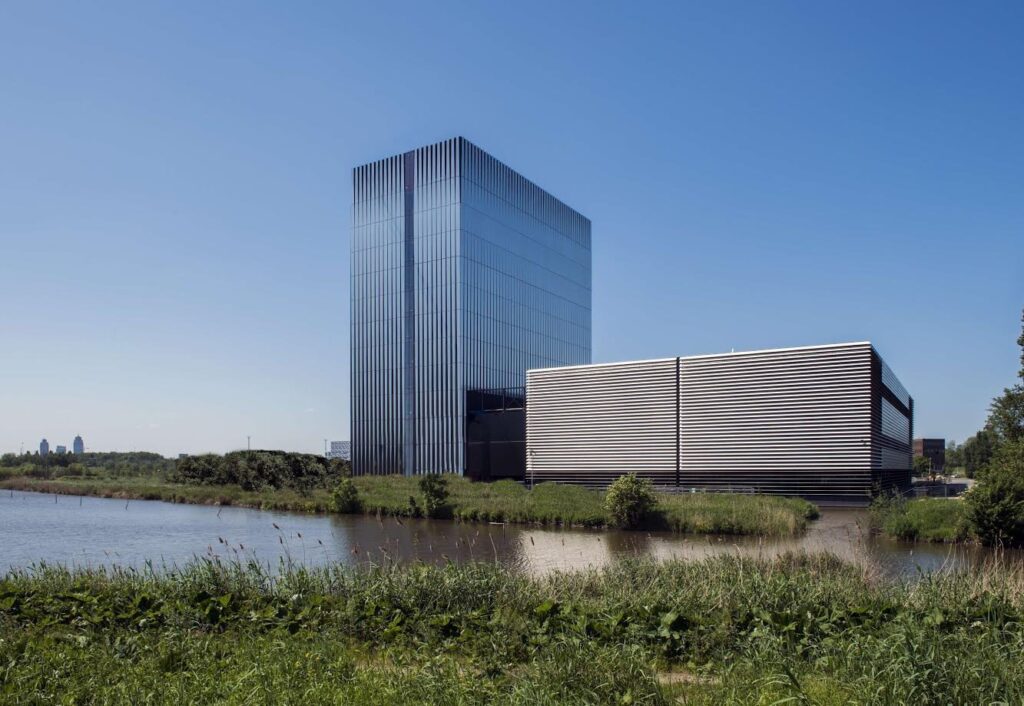
Wind loading on tall buildings has a significant effect on the structural safety of those buildings. Wind induced façade failures are costly and dangerous to lives. It is therefore important to know in advance the characteristics of the wind loads acting on a building façade. Furthermore, wind loading is a governing parameter in the design of the foundation and superstructure of tall buildings. Cost efficient design of these components requires reliable quantification of the wind loading.
We primarily provide wind loading studies for structural engineers and façade engineers who require detailed and reliable information on wind-induced loads to be considered in their engineering design.
While the Eurocode (EN 1991-1-4), as well as other building codes, offers general guidelines for calculating overall wind pressures on simple building geometries, our wind loading studies based on wind tunnel testing deliver significantly more detailed insights. These studies capture the spatial variation of wind loads across all building façades and structural elements.
This precise and more detailed information enables engineers to verify structural safety with greater confidence and, at the same time, to optimise structural and façade designs in a more cost-efficient manner.
For example, in façade zones where wind loads are relatively low, cladding fixings and attachments can be designed with reduced requirements, resulting in material and cost savings.
We offer a range of services to support structural and façade engineers in assessing wind loads on building structures and façades:
For simple building geometries in isolated conditions, we can calculate wind pressures based on guidelines outlined in the governing building codes (e.g. Eurocode EN1991-1-4). The results of these calculations can be considered highly conservative. However, these code-based calculations are always a good reference point, even when a more elaborate wind loading study is considered in a later stage.
While CFD simulations are not recommended for determining actual peak wind loads on a building, they are a useful tool for estimating overall wind effects during the early design phase. Simulations can be used to compare wind loads between alternative design concepts or to assess the impact of major design modifications. Results from CFD studies are intended for design guidance and conceptual comparison, not for quantifying the exact wind loads on the building.
Wind tunnel testing is the most accurate method for assessing wind loads on building structures. Unlike code-based calculations, it can handle complex building geometries and surrounding environments. Wind tunnel studies are typically conducted during the detailed design phase, when all building and façade details are available. In a wind tunnel study, we address two main types of wind loads:
For wind loading assessments, we prefer to use wind tunnel testing to adequately capture peak wind loads. We have access to wind tunnel facilities both in the Netherlands and in the UK.
For very simple building geometries or early phase assessments, we may use code-based calculations or numerical simulations to estimate wind loads on cladding or building structures. These results can then serve as input for the design process, for example, to compare and select the most suitable design option.
For more details on the different approaches, please refer to our services section above.
Used tools:



Our code-based calculations and our wind tunnel studies are fully compliant with the governing building codes. In Europe, we follow the methods and guidelines outlined in the Eurocode (EN1991-1-4) and the relevant national annexes. For our projects in the Middle East, we mainly follow the local building codes.





Our expertise is only a few clicks away. Just send us an email or fill out the form on our contact page, and one of our experts will contact you as soon as possible.

Made by 