
Wind Engineering
Windmill biotopes
We study the impact of a new building on the operation of historical windmills
Wind Engineering
We study the impact of a new building on the operation of historical windmills
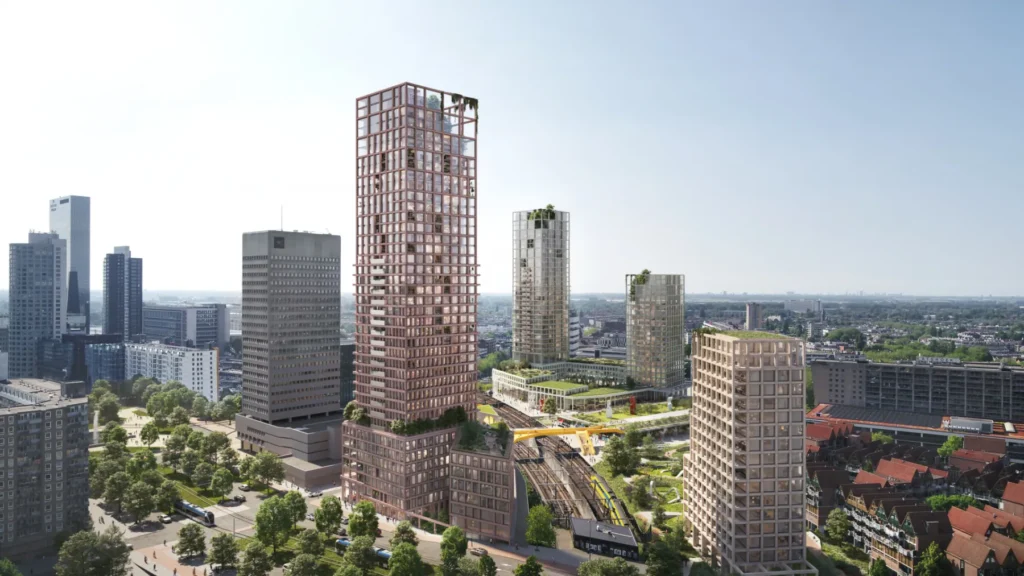
The Netherlands is world-famous for its historic windmills. Originally constructed in open landscapes, many of these mills are now located near expanding urban areas. As cities grow and new buildings are constructed, the local wind climate is influenced and as such the ability of windmills to capture wind.
When new developments are planned within the vicinity of a historic windmill, it is essential to assess the impact on mill’s operational performance. A windmill biotope study evaluates how a proposed building affects wind availability and the number of operational hours of a mill.
At Actiflow, we help to enable sustainable urban development while safeguarding valuable cultural heritage. This typically requires an integral approach involving all stakeholders: real estate developers, urban planners, millers, windmill foundations, municipalities and planning authorities. By cooperating, we ensure that historic windmills remain functional for generations to come.
When new (high-rise) buildings are planned within several hundreds of metres of a historic windmill, we assist developers to study the impact of the proposed project on the windmill’s wind capture and operation. For new masterplans or urban developments, the responsibility for conducting a wind study often lies with the planning authorities.
In other cases, we support millers if they believe a proposed development could negatively affect the mill’s performance.
Depending on the project scope and the specific research questions, we offer two types of windmill biotope assessments:
A biotope quick scan provides a fast, cost-effective initial assessment.
The study begins with a simplified windmill biotope equation to determine the maximum allowable building height as a function of the distance from the windmill. If the proposed building exceeds this limit, we estimate the expected reduction in the windmill’s operational hours based on the direction and distance of the proposed building relative to the windmill, as well as local statistical wind data.
The quick scan assumes no wind recovery downstream of the proposed building. As a result, it represents a conservative, worst-case assessment.
For more complex projects, we conduct a detailed windmill biotope study using Computational Fluid Dynamics (CFD) simulations.
This study includes:
This “before and after” approach enables an accurate assessment of the actual impact of the proposed development on the windmill’s operational hours.
Currently, there is no universally accepted standard methodology for conducting windmill biotope studies in scientific literature or regulations.
At Actiflow, we apply a methodology based on steady-state CFD simulations, which we consider the most practical and reliable approach available today.
Compared to simplified distance-height equations, CFD simulations provide:
By combining CFD results with long-term statistical wind data, we calculate the reduction in operational hours in a scientifically robust yet practical manner.
Like any modelling technique, steady-state CFD simulations have their limitations:
We acknowledge these limitations and ensure that results are interpreted accordingly. Despite these limitations, steady-state CFD offers an optimal balance between physical accuracy, computational feasibility, and project budget.
For developers, municipalities, and millers, our CFD-based windmill biotope studies provide relevant, realistic and transparent insights.

Our expertise is only a few clicks away. Just send us an email or fill out the form on our contact page, and one of our experts will contact you as soon as possible.

Made by 