

Wind Engineering
Pollutant dispersion
We analyze and predict pollutant dispersion in urban, industrial and offshore environments
Wind Engineering
We analyze and predict pollutant dispersion in urban, industrial and offshore environments
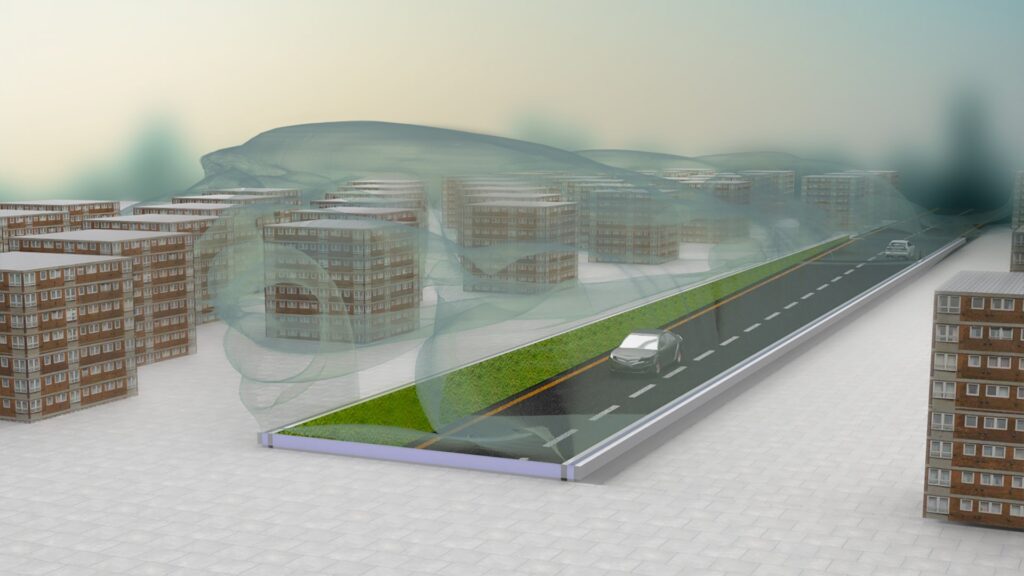
Pollutant dispersion covers a wide range of challenges related to how gases and particles are transported by wind. In urban environments pollutants from road traffic, industrial activities, and other emission sources can spread through the city and affect air quality and public health.
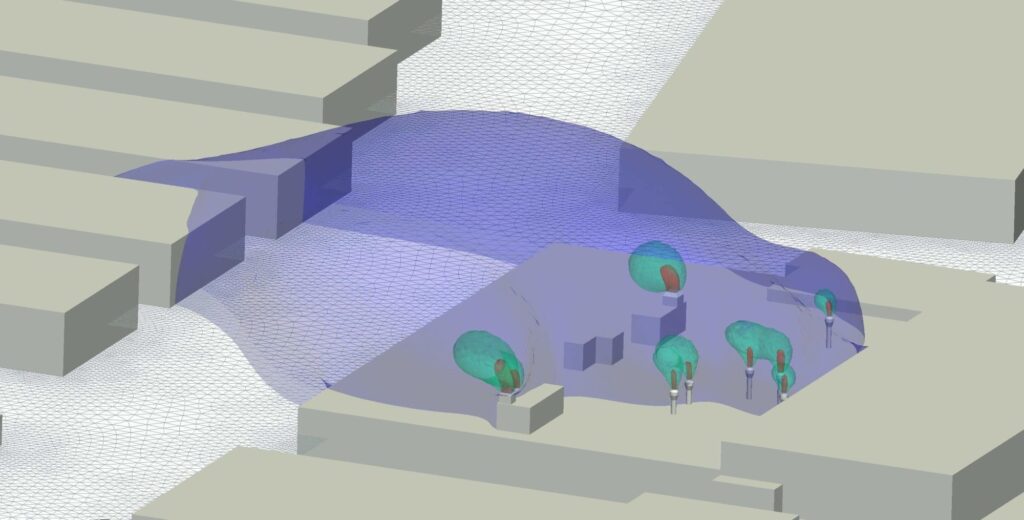
At a smaller scale, HVAC exhausts can interfere with air intake openings, causing short-circuiting between supply and exhaust airflows. This can lead to contamination, reduced system efficiency, and health and comfort issues. Similar phenomena occur in industrial facilities, as well as on ships and offshore platforms, where airflow interactions are often complex.
Because pollutant dispersion occurs in many different contexts, our clients operate across a wide range of sectors, including:
We offer pollutant dispersion studies which are used in the design stage of a system, product or building, or when complaints or incidents arise.
Evaluating possible pollutant dispersion during the design phase is most effective. Early analysis helps prevent contamination risks and avoids costly, complex mitigation measures later in the project lifecycle. However, sometimes we are faced with existing situations which are problematic. In such cases, we first identify and validate the source of the problem. We then assess potential mitigation measures through simulation, ensuring the proposed solution is effective before implementation.
Pollutant dispersion is strongly influenced by wind flow. Key factors include wind direction, wind speed, and air temperature, all of which affect how gases and particles travel from a source to a receiver. Therefore, our studies typically consider a wide range of wind conditions to assess sensitivity and risk. By combining local wind statistics with temperature distributions, we perform a statistically robust risk analysis.
If the assessed risk is unacceptable, mitigation measures can be proposed and subsequently validated through additional Computational Fluid Dynamics (CFD) simulations.
Computational Fluid Dynamics (CFD) is the most reliable tool for predicting pollutant dispersion at both large and small scales. For each study, we build a detailed three-dimensional CAD model that includes all relevant geometric features to ensure accurate and problem-specific results.
In close collaboration with the client, we define:
External boundary conditions are derived from local wind statistics and temperature data. Based on this information, a representative set of simulation scenarios is defined to fully assess the dispersion risk.
After completing the simulations, we analyze the results by:
When required, mitigation measures can be developed based on the CFD results. After discussion and approval, additional simulations can be performed to demonstrate and verify the effectiveness of these measures.
Made by 