

Indoor climate & air quality
Operating rooms
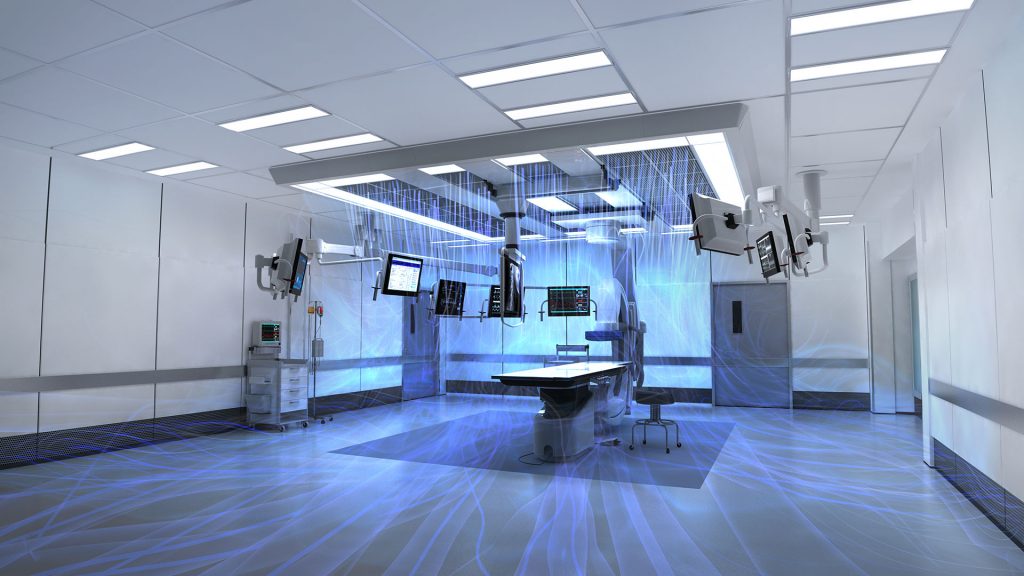
Visualising airflow and particle concentrations in operating rooms
Indoor climate & air quality
Visualising airflow and particle concentrations in operating rooms
In operating rooms, airflow patterns play a crucial role in patient safety. The way air moves through the room largely determines the risk of contamination at the surgical site. To control airflow and reduce contamination risks, operating rooms are equipped with dedicated HVAC systems. These systems are typically based on either displacement ventilation principles (such as ceiling-mounted downflow systems) or air mixing concepts.
Actiflow uses advanced Computational Fluid Dynamics (CFD) simulations to visualise airflow behaviour and particle dispersion in operating rooms. This allows us to assess, optimise, and validate air quality, ensuring that ventilation systems effectively protect the patient during surgical procedures.
We work with a wide range of stakeholders involved in operating room design and operation, including:
For manufacturers, we provide CFD-based support throughout the research and development phase of their products. As operating room design becomes increasingly modular and flexible, ensuring consistent air quality in the patient area is more challenging. Our simulations help manufacturers verify that their systems maintain the required air cleanliness under a wide range of configurations and use scenarios.
For hospitals, we evaluate the performance of existing operating rooms, validate designs of new rooms proposed by suppliers, and provide advice for renovation projects. While air quality testing during commissioning is usually performed in empty rooms, we also assess real-life conditions by analysing airflow and particle behaviour when the operating room is fully operational, including personnel and equipment.
We help our clients to make sure that particles released by medical staff, equipment, or surgical activities are effectively removed from the patient zone.
We use CFD simulations to visualise airflow patterns and particle concentrations in operating rooms across multiple scenarios. Personnel, medical equipment, operating lights, and furniture can be added or removed from the model, while HVAC system dimensions and operating parameters can be adjusted. This allows us to optimise ventilation performance and achieve optimal air quality in the patient zone.
When constructing new operating rooms, hospitals often assume that air quality requirements are fully guaranteed by suppliers or manufacturers. In practice, this is not always the case. We help hospitals independently verify that their operating rooms comply with relevant standards and performance criteria.
When existing operating rooms are renovated – for example due to a change in layout, function, or equipment – it is essential to ensure that airflow performance and patient protection remain adequate. Through CFD simulations, we assess the impact of renovation plans in advance and, if necessary, advise on modifications to the HVAC system to maintain or improve air quality.
Our primary tool for assessing the air quality in operating rooms is Computational Fluid Dynamics (CFD). When required, we complement simulations with on-site measurements to characterise the performance of existing HVAC systems.
Measured data are used as input for our CFD models, ensuring reliable and realistic simulation results. This combined approach enables us to deliver robust, data-driven insights into airflow behaviour, particle dispersion, and overall operating room performance.
Each project starts with the development of a detailed 3D model of the operating room, which may include:
Depending on the project objectives, we simulate either:
A key input for the simulations is the ventilation and filtration system, which typically consists of ceiling-mounted downflow units or air jets, combined with low-level exhaust openings for air recirculation.
A computational mesh is created within the operating room geometry, after which simulations are performed based on defined boundary conditions. Typical CFD results include:
Based on the simulation outcomes, we propose mitigation measures and optimisation strategies. Where relevant, the impact of design changes can be evaluated through additional CFD simulations.

Made by 