

Indoor climate & air quality
Cleanrooms
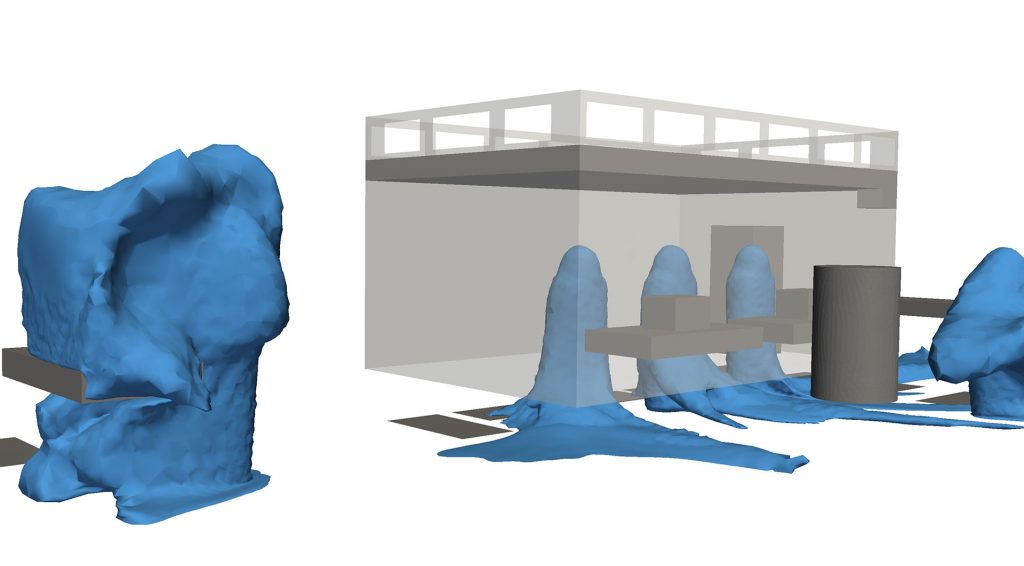
Visualising airflow and particle concentrations in cleanrooms
Indoor climate & air quality
Visualising airflow and particle concentrations in cleanrooms
Cleanrooms are widely used in semiconductor, pharmaceutical, biotech, and any other industry that requires a strictly controlled production environment. Whether for the design of new cleanrooms or the renovation of existing facilities, our Computational Fluid Dynamics (CFD) simulations help ensure low particle concentrations, optimal airflow, and minimum energy consumption, while fully complying with the required ISO cleanroom classifications.
By accurately simulating airflow patterns and pollutant dispersion, we enable our clients to design and operate cleanrooms that are both high-performance and energy efficient.
Depending on the project phase and objectives, we collaborate with cleanroom designers, HVAC engineers and cleanroom users. We are typically involved during:
There is growing awareness in the market that designing cleanrooms based solely on prescribed air change rates often leads to overly conservative and energy-intensive solutions. Our clients therefore choose to go beyond rule-of-thumb approaches and simulate airflow and particle concentrations in detail.
This approach allows them to:
In most projects, our clients seek insight into future operating scenarios. For renovation projects, the current situation may also be analysed. In all cases, we provide actionable insights and practical recommendations for HVAC optimisation.
For clients in the cleanroom sector, we perform CFD simulations to assess the air quality, airflow behaviour, and particle dispersion within cleanrooms.
A key input for the simulations is the design of the ventilation and filtration system. In most cleanrooms, this includes ceiling-mounted filter-fan units (FFU’s), and openings in floors, walls or columns for recirculation of the air.
Based on our simulation results, we propose mitigation measures and optimisation options for the ventilation and HVAC system with the goal to reduce energy consumption, improve airflow uniformity and reduce particle concentrations. Where relevant, the impact of design changes can be evaluated through additional CFD simulations.
For existing cleanrooms, the exact characteristics of the ventilation system are sometimes unknown. In such cases, we perform on-site airflow measurements to determine the right boundary conditions for our simulations.
Our primary tool for assessing cleanroom air quality is Computational Fluid Dynamics (CFD). When required, we complement simulations with on-site measurements to characterise HVAC system performance in existing cleanrooms.
The measured data are used as input for our CFD models, ensuring reliable and realistic simulation results. This combined approach allows us to deliver robust, data-driven insights into airflow behaviour, particle dispersion, and cleanroom performance.
Our work starts with setting up a suitable 3D model of the cleanroom, including:
A key input for the simulations is the design of the ventilation and filtration system. In most cleanrooms, this includes ceiling-mounted filter-fan units (FFU’s), and openings in floors, walls or columns for recirculation of the air.
Inside the cleanroom, we build a computational mesh to accommodate the CFD simulations. Based on defined boundary conditions, we perform the simulations, typically delivering the following results:
Based on our simulation results, we propose mitigation measures and optimisation options for the ventilation and HVAC system. Where relevant, the impact of design changes can be evaluated through additional CFD simulations.
Made by 